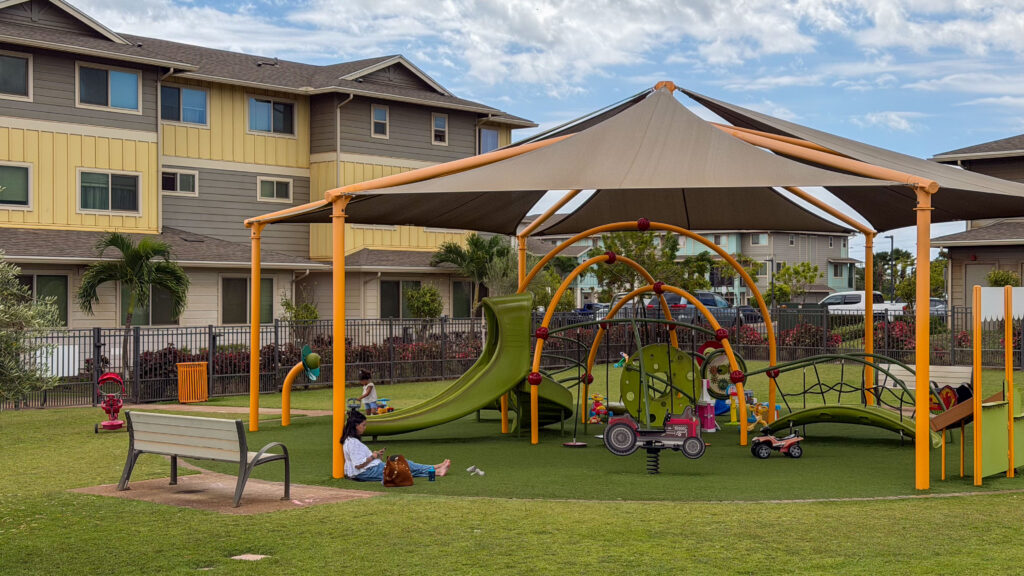
Several Oahu new construction developments accept VA loans in 2026, including Hoʻopili in ʻEwa Beach and Koa Ridge in Central Oahu—both offering $0 down, no PMI, and competitive rates for eligible military buyers. This guide covers which developments currently accept VA financing, the step-by-step buying process, and how to choose a community based on your duty station.
VA Loan Benefits for New Construction in Hawaii
If you’re active-duty military or a veteran in Hawaii, your VA loan benefit is one of the most powerful homebuying tools available—especially for new construction. Here’s what makes VA financing stand out for brand-new homes on Oahu:
- $0 down payment. No down payment required regardless of purchase price. Since VA loan limits were eliminated in 2020 for borrowers with full entitlement, you can finance a $900,000 Hoʻopili home with nothing down.
- No private mortgage insurance (PMI). Conventional loans require PMI below 20% down. VA loans never charge PMI, saving you $300–$600/month on a typical Hawaii purchase.
- Competitive interest rates. VA rates typically run 0.25%–0.50% lower than conventional rates because the government guaranty reduces lender risk.
- No prepayment penalty. If PCS orders move you, you can sell or pay off the loan anytime with zero penalty.
- VA appraisal protects you. The VA appraisal ensures you’re not overpaying, and the VA’s Minimum Property Requirements (MPRs) guarantee the home meets quality standards—less of a concern with new construction, but still valuable.
For a full overview of the new construction buying process in Hawaii (beyond VA-specific steps), see our guide to buying new construction in Hawaii.
Which Oahu Developments Accept VA Loans in 2026
Not every new construction development in Hawaii accepts VA financing. Developers must meet specific VA requirements, and some—particularly luxury high-rise condos—choose not to pursue VA approval. Here’s the current landscape for military home buyers on Oahu:
Hoʻopili (ʻEwa Beach) — VA Accepted
Hoʻopili is the most popular choice for military buyers using VA loans. This master-planned community in ʻEwa Beach offers condos, townhomes and single-family homes across multiple neighborhoods. Prices change with each release; see current prices on our Hoʻopili page. Neighborhoods like Kapili and Ahakea have been particularly popular with military families thanks to their floor plan sizes and proximity to Joint Base Pearl Harbor-Hickam (JBPHH).
D.R. Horton’s affiliated lender sometimes offers financing incentives on select Hoʻopili homes. Terms change often, so ask the sales office what applies to the home you want, compare it with a quote from your own VA lender, and see our Hoʻopili page for current releases.
Key details for VA buyers at Hoʻopili:
- Nanahea, ʻAhakea, Kāpili and Alana appear as VA-accepted in the VA condo report (checked October 30, 2026). We found no listing for Uluwehi, so ask the sales office.
- The developer (D.R. Horton) has extensive experience with VA transactions
- Approximately 15–20 minute commute to JBPHH
- Multiple active neighborhoods with ongoing sales
Koa Ridge (Central Oahu) — VA Accepted
Koa Ridge in Central Oahu is another strong option for VA buyers, particularly those stationed at Schofield Barracks or Wheeler Army Airfield. With neighborhoods like Nanea III, Koa Ridge offers single-family homes in a master-planned setting with mountain views and a more suburban feel.
Key details for VA buyers at Koa Ridge:
- Nanea III, Walea II, Lau Leʻa (Phase I) and Keʻolu (Phase I) appear as VA-accepted in the VA condo report (checked October 30, 2026). Keʻolu Phase II is pending, Puaola Phase I shows as rejected (October 29, 2026), and we found no listing yet for Mau Loa. Confirm the phase you’re buying in.
- Castle & Cooke is the master developer; individual builders vary by neighborhood
- Roughly 10–15 minute commute to Schofield Barracks
- Growing community with new retail, schools, and parks planned
Gentry Communities (ʻEwa & Kalaeloa) — VA Accepted
Gentry Homes accepts VA financing (alongside FHA, USDA, and conventional) at its West Oʻahu communities, including Kaʻulu by Gentry in Kalaeloa. Gentry’s incentive structure is typically tied to using its preferred lender, Gentry HomeLoans (a venture with Central Pacific Bank) — confirm the current credit terms and each release’s VA status with the sales office, since townhome and condo-regime phases need project-level approval just like towers.
Ward Village (Kakaʻako) — Limited VA Acceptance
Ward Village is Honolulu’s premier urban development, but VA financing is limited for high-rise condos. Condo projects must receive VA approval as a whole (not just individual units). In the VA condo report (checked October 30, 2026), Aeʻo, Anaha, Kōʻula, Victoria Place and Ulana show as accepted and ʻAʻaliʻi as suspended; we found no listing under the names Waiea, Ke Kilohana, The Park or Kalae. If you’re considering Ward Village with a VA loan, confirm the specific tower’s VA status with your lender before proceeding — search the project’s legal name in the VA condo database.
The pre-sale trap: you can sign a pre-sale contract on a tower that isn’t VA-approved, but your VA loan can only close once the building is substantially complete and the project holds VA approval. If the developer never pursues approval, a VA buyer is stranded at closing. Projects can obtain VA approval while still under construction (38 CFR § 36.4365 covers “proposed” condos, requiring recorded documents, structural certifications, builder warranties, and a threshold of bona fide sales), but many towers apply only near or after completion, and some never do. Get the tower’s approval status — or the developer’s written commitment to pursue it — before you deposit.
Developments That Typically Don’t Accept VA
Urban luxury condo towers in Kakaʻako and Ward often skip VA approval because:
- The VA approval process for condos is lengthy and requires developer participation
- Luxury price points attract buyers who typically use conventional financing
- HOA structures and mixed-use zoning can complicate VA requirements
If you’re set on an urban condo lifestyle, ask your VA-savvy lender to check the VA’s approved condo list for the specific project.
One myth to ignore: there is no VA “spot” or single-unit condo approval. That’s an FHA feature that mortgage blogs often misattribute to VA. If the whole project isn’t VA-approved, no unit in it can close on VA financing.
Step-by-Step: Buying VA Loan New Construction in Hawaii
The process for using a VA loan on new construction differs from a standard resale purchase. Here’s what to expect from start to keys-in-hand:
Step 1: Confirm Your VA Eligibility
Request your Certificate of Eligibility (COE) through your lender, online at VA.gov, or by mail with VA Form 26-1880. You’ll need this before any serious shopping. Active-duty service members, veterans with qualifying service, and eligible surviving spouses can all use the VA benefit.
Step 2: Get Pre-Qualified with a Hawaii VA Lender
Work with a lender experienced in Hawaii VA transactions—not all lenders understand the local market. Pre-qualification tells you your maximum purchase price and shows developers you’re a serious buyer. This is especially important for competitive developments like Hoʻopili, where some neighborhoods use a lottery system.
Step 3: Verify the Development’s VA Approval Status
Before falling in love with a floor plan, confirm the development and specific neighborhood accept VA financing. For single-family homes and townhomes in Hoʻopili and Koa Ridge, this is typically straightforward. For condos, search the project’s legal name in the VA condo database and ask the sales office directly. In Hawaiʻi, CPR phases can be approved separately — confirm the status for your specific phase or increment.
Step 4: Select Your Home & Sign the Purchase Agreement
Once you’ve chosen a neighborhood and floor plan, you’ll sign a purchase agreement with the developer. For new construction, you may be buying a home that’s already built, under construction, or not yet started—each scenario affects your timeline differently.
Step 5: VA Appraisal
The VA will order an independent appraisal to confirm the home’s value meets or exceeds the purchase price. For new construction, the appraiser also verifies the home meets VA Minimum Property Requirements (MPRs). New homes almost always pass MPRs since they’re built to current code, but the appraisal can still come in below the purchase price in a hot market.
Step 6: Construction Completion & Final Inspection
The builder must provide a one-year warranty on VA Form 26-1859 (Warranty of Completion of Construction) or a HUD-accepted 10-year insured protection plan — get it in writing at closing. If your home is still under construction at contract signing, you’ll wait for completion. The VA does not typically allow “construction-to-permanent” loans through the standard VA program—you’re buying a home that will be completed by the developer. Once built, a final inspection confirms everything matches the plans.
Step 7: Closing
At closing, you’ll pay the VA funding fee (which can be financed into the loan), any negotiated closing costs, and move in. The VA funding fee ranges from 1.25%–3.3% depending on your down payment and whether it’s your first VA loan use. Veterans who receive VA compensation for a service-connected disability are exempt, as are some others, such as active-duty Purple Heart recipients.
Choosing a Development by Base Proximity
For military buyers in Hawaii, commute to your duty station is often the deciding factor. Here’s how Oahu’s new construction developments line up:
| Development | Nearest Base | Approx. Commute | Price Range | VA Status |
|---|---|---|---|---|
| Hoʻopili | JBPHH | 15–20 min | See current prices | Most phases accepted |
| Koa Ridge | Schofield Barracks | 10–15 min | See current prices | Most phases accepted |
| Ward Village | JBPHH | 20–25 min | See current prices | Limited |
Stationed at JBPHH? Hoʻopili is your best bet for new construction with VA financing. The commute is manageable, and the family-friendly neighborhoods align well with military life. See our Hoʻopili vs Koa Ridge comparison for a detailed breakdown.
Stationed at Schofield Barracks or Wheeler AAF? Koa Ridge puts you minutes from the gate. Central Oahu also offers easier access to North Shore recreation on weekends.
Stationed at Marine Corps Base Hawaiʻi (Kāneʻohe)? Neither Hoʻopili nor Koa Ridge is particularly close to MCBH (30–45 minute commutes). For Windward-side military families, resale homes in Kāneʻohe or Kailua may be worth exploring alongside new construction options.
Common Pitfalls for VA Buyers in Hawaii New Construction
Using a VA loan on new construction is straightforward when you know what to watch for. Avoid these common mistakes:
- Assuming all new construction accepts VA. Always verify before committing. Urban high-rise condos are the most common exception.
- Using a lender unfamiliar with Hawaii. Mainland-based VA lenders may not understand Hawaii’s unique market dynamics, developer requirements, or timelines. Choose a local lender with VA experience.
- Ignoring the VA funding fee in your budget. While you can roll it into the loan, it still adds to your total mortgage. First-time VA users with $0 down pay a 2.15% funding fee—on a $750,000 home, that’s $16,125.
- Not planning for PCS. Hawaii tours are typically 3 years. Consider whether you’ll keep the home as a rental or sell. New construction often holds value well, but factor in HOA fees, property taxes, and potential rental income.
- Waiting too long to start. Popular neighborhoods at Hoʻopili sell through lottery, and Koa Ridge phases can sell out quickly. Begin your VA pre-qualification early so you’re ready when inventory opens.
BAH & Budgeting for Your Hawaii VA Purchase
Your Basic Allowance for Housing (BAH) is a key factor in determining how much home you can afford. Honolulu’s BAH is among the highest in the nation, reflecting Hawaii’s cost of living. The 2026 rate for an E-6 with dependents in Honolulu County is $3,912 a month (DTMO rates effective January 1, 2026). That covers a large share of the principal and interest on a home in the $650K–$800K range. Rates reset every January, so check yours in the DTMO BAH calculator.
When budgeting, consider:
- Monthly mortgage payment: With $0 down on a $750,000 home at an example rate of 7%, principal and interest come to roughly $5,000/month. Rates change weekly, so get a current quote from your lender.
- Property taxes: Hawaii has the lowest effective property tax rate in the U.S. (~0.28%), but new homes are assessed at full value. Budget $175–$250/month.
- HOA fees: Vary by development. At Hoʻopili, 2025–2026 public reports put total association fees at about $160–$850/month, including master dues, depending on the neighborhood and home type. See our Hoʻopili HOA fees guide for specifics.
- Homeowner’s insurance: $100–$200/month for a standard policy.
- VA funding fee (if financed): Adds about $70–$110/month on a $500K–$750K home at a 7% example rate.
Tip: Your VA lender can run a detailed affordability analysis using your specific BAH rate and other income. Don’t rely on online calculators that don’t account for Hawaii’s tax advantages.
Timeline: VA Appraisals for New Construction vs Resale
The VA appraisal process for new construction differs from resale in a few important ways:
| Factor | New Construction | Resale |
|---|---|---|
| Appraisal timing | After construction is substantially complete | After accepted offer |
| Typical turnaround | 10–21 days | 10–14 days |
| MPR concerns | Minimal (new code compliance) | Possible repairs needed |
| Appraisal challenges | Limited comps in new phases | More established comps |
| Total closing timeline | 30–60 days from completion | 30–45 days from offer |
The biggest timeline variable for new construction is construction completion itself. If you’re buying a home that’s already built or nearly complete, the process moves similarly to a resale. If construction hasn’t started, you may wait 6–18 months before closing—but you lock in today’s pricing.
Frequently Asked Questions About VA Loans for New Construction in Hawaii
Can I use a VA loan to buy new construction in Hawaii?
Yes. Several Oahu developments accept VA loans for new construction, including Hoʻopili in ʻEwa Beach and Koa Ridge in Central Oahu. You’ll need a Certificate of Eligibility and a lender experienced with Hawaii VA transactions. The process is similar to a standard VA purchase, with the added step of verifying the development’s VA approval status.
Which Oahu developments accept VA loans in 2026?
Most current Hoʻopili (ʻEwa Beach) and Koa Ridge (Central Oahu) neighborhoods show as VA-accepted in the VA condo report (checked October 30, 2026). Approval is granted phase by phase, so confirm the phase you want. Ward Village in Kakaʻako has limited VA acceptance—individual condo towers vary. Always confirm the specific neighborhood or tower’s VA status before committing.
Is there a VA loan limit for Hawaii in 2026?
No. Since 2020, VA loan limits have been eliminated for borrowers with full entitlement. You can purchase a home at any price point with $0 down, as long as you qualify based on income, credit, and debt-to-income ratio. If you’ve used your VA benefit before and haven’t restored full entitlement, county loan limits may apply.
How much is the VA funding fee on new construction?
The VA funding fee for a first-time VA loan with $0 down is 2.15% of the purchase price. On a $750,000 home, that’s $16,125. The fee can be financed into the loan. Subsequent uses increase to 3.3%. Veterans who receive VA compensation for a service-connected disability are exempt, as are some others listed on VA.gov.
Can I use a VA loan for a condo in Ward Village?
It depends on the specific tower. Condo projects must receive VA approval as a whole (there is no single-unit approval), and many luxury towers in Kakaʻako have not pursued it. On a pre-sale, your VA loan can only close once the tower is complete and VA-approved — confirm status before depositing. Check the VA’s approved condo list or ask the Ward Village sales office about VA status for the tower you’re interested in.
How long does the VA appraisal take for new construction in Hawaii?
VA appraisals for new construction typically take 10–21 days on Oahu. The appraisal happens after the home is substantially complete. The biggest timeline factor is construction completion itself—if you’re buying a to-be-built home, expect 6–18 months before closing.
What happens if the VA appraisal comes in low on new construction?
If the VA appraisal is below the purchase price, you have options: negotiate a lower price with the developer, pay the difference out of pocket, or walk away (most purchase agreements include an appraisal contingency). New construction in developing neighborhoods sometimes faces appraisal challenges due to limited comparable sales.
Should I buy at Hoʻopili or Koa Ridge with my VA loan?
It depends on your duty station. If you’re at JBPHH, Hoʻopili is 15–20 minutes away with more inventory. If you’re at Schofield Barracks, Koa Ridge is 10–15 minutes away with a quieter, more suburban setting. Both accept VA loans and offer family-friendly communities. See our Hoʻopili vs Koa Ridge comparison for a full breakdown.
Your next step
Buying new for the first time?
Team Wong can walk you through the contract, the deposits and the timeline before you visit a sales office.
Ask Team Wong