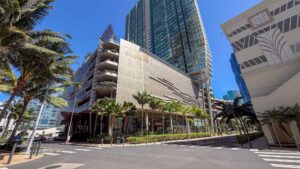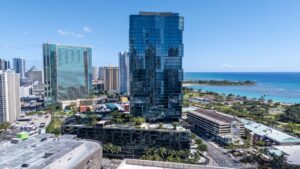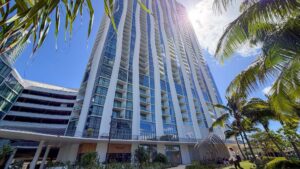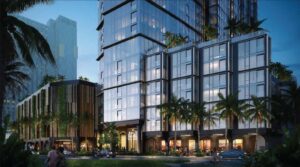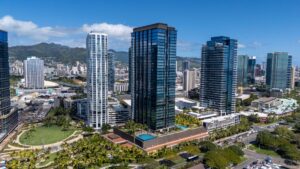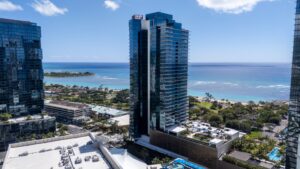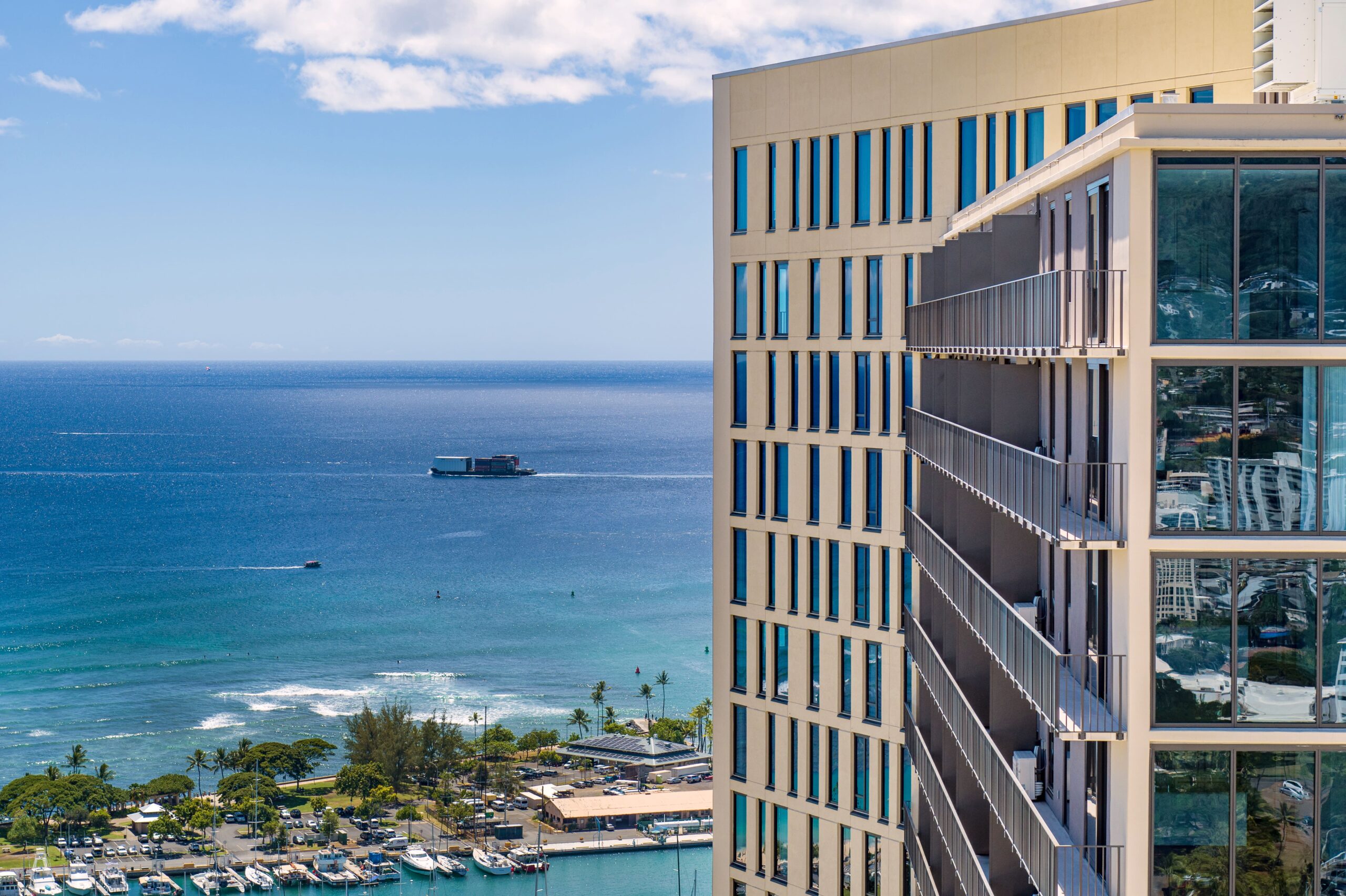
ʻAʻaliʻi is a 42-story, 751-unit condominium tower completed in 2021 at 987 Queen Street in Kakaʻako’s Ward Village—the largest residential building by unit count in the entire master-planned community. Developed by The Howard Hughes Corporation as Ward Village’s sixth residential tower, ʻAʻaliʻi pioneered the “smart living” micro-unit concept in Honolulu’s luxury condo market, offering compact studios from 280 square feet alongside one- and two-bedroom units up to 900 square feet. The name “ʻAʻaliʻi” refers to a native Hawaiian shrub with strong, resilient wood, symbolizing the building’s role in providing attainable, durable housing solutions.
Quick Facts: ʻAʻaliʻi at a Glance
- Address: 987 Queen Street (also listed as 987 Auahi Street), Honolulu, HI 96814
- Completion Year: 2021
- Developer: The Howard Hughes Corporation / Victoria Ward Limited
- Construction Company: PCL Construction
- Architect: Solomon Cordwell Buenz (also designed Anaha at Ward Village)
- Interior Design: Rottet Studios (Hall of Fame designer Lauren Rottet)
- Height: 42 stories (~420 feet)
- Total Units: 751 (601 market-rate + 150 reserved housing)
- Unit Mix: Studios, 1-2 bedroom condos, 280-900 sq ft
- Parking: Approximately 940 stalls (ground level and podium floors)
- Retail: Ground-floor retail spaces (various tenants)
- Original Pricing: Mid $300Ks (studios) to $1.2M+ (two-bedrooms)
- Current Resale Pricing: $605K-$1.4M (Aug 2026; lower-priced micro-studios absorbed)
Building Specifications: Ward Village’s Largest Tower
ʻAʻaliʻi contains 751 residential units across 42 stories, making it the highest-density residential building in Ward Village and one of the largest condo towers in Hawaiʻi by unit count. This unprecedented scale reflects Howard Hughes Corporation’s strategic response to market demand analysis showing strong appetite for smaller, more affordable units that maintain luxury amenities and prime location.
Chicago-based architect Solomon Cordwell Buenz (who previously designed Ward Village’s Anaha tower) brought their expertise in high-density urban residential design to ʻAʻaliʻi. Their design maximizes efficiency while maintaining quality, creating layouts that feel spacious despite compact square footage. Interior designer Lauren Rottet of Rottet Studios—a Hall of Fame designer known for luxury hotels including Four Seasons properties—elevated finishes and details beyond typical “affordable luxury” standards.
The building’s facade features clean lines and generous glass, creating visual lightness despite its substantial mass. The tower sits adjacent to Ae’o (the Whole Foods tower), benefiting from proximity to grocery access while maintaining its own identity.
Unit Mix Breakdown: The Micro-Unit Strategy
ʻAʻaliʻi offers 751 units ranging from micro-studios at 280 square feet to two-bedroom units reaching 900 square feet—significantly smaller than typical luxury condos but designed for maximum efficiency. This unit mix targets first-time buyers, young professionals, downsizers, and investors seeking affordable entry into Ward Village’s luxury market.
| Unit Type | Approximate Count | Size Range (sq ft) | Current Resale Range (Feb 2026) |
|---|---|---|---|
| Micro-Studio | ~250 | 280-367 | $515K-$578K |
| Studio | ~200 | 379-473 | $532K-$715K |
| 1-Bedroom | ~220 | 473-582 | $715K-$755K |
| 2-Bedroom | ~81 | 824-900 | $988K-$1,375K |
The micro-studio concept (280-367 square feet) represented a bold experiment in Honolulu’s market, where even “compact” condos typically start at 400-500 square feet. To make these units livable, Howard Hughes and Rottet Studios incorporated transforming furniture, built-in storage, and efficient layouts that maximize every inch.
Smart Living Features: Making Small Spaces Work
ʻAʻaliʻi pioneered “smart living” design in Honolulu, incorporating transforming furniture, hidden storage, and technology integration to maximize functionality in compact spaces. Many units include:
- Murphy Beds: Wall beds that fold away, converting bedrooms into living/work spaces during the day
- Transforming Tables: Desks that convert to dining tables for entertaining
- Built-In Storage: Clever cabinetry maximizing vertical space and eliminating clutter
- Integrated Appliances: Compact, efficient kitchen appliances designed for small spaces
- Floor-to-Ceiling Windows: Abundant natural light creates sense of openness
The building also features a proprietary resident app for booking amenities (BBQ cabanas, party rooms, yoga studio), contacting concierge, tracking packages, and managing access—reflecting the “smart” technology integration that defines ʻAʻaliʻi’s brand.
Reserved Housing Component
150 of ʻAʻaliʻi’s 751 units (20%) are designated as reserved housing serving households earning 100-140% of Area Median Income. This fulfills Hawaiʻi Community Development Authority (HCDA) requirements for Kakaʻako developments while providing middle-income buyers access to Ward Village’s luxury amenities at subsidized prices.
Reserved housing units were priced significantly below market rates (approximately 25-40% discount) but carry perpetual shared equity requirements, meaning sellers must repay a portion of appreciation to HCDA to fund future affordable housing. Buyers must meet income limits, residency requirements, and other eligibility criteria.
The 601 market-rate units face no such restrictions and trade freely on the open market, generating the pricing data reflected in this article.
Parking & Transportation
ʻAʻaliʻi provides approximately 940 parking stalls, translating to approximately 1.25 stalls per unit. Most studios include one parking space, while two-bedroom units receive two stalls. This parking ratio is lower than older luxury buildings but reflects urban planning trends encouraging transit use and walkability.
The building features extensive secure bicycle storage on the ground level, with both resident storage and retail bike parking near ground-floor retail areas. This infrastructure supports car-free living for residents comfortable cycling to work or running errands by bike.
Honolulu’s Skyline rail already connects East Kapolei to Middle Street (Segment 2 opened October 2025), and a Kakaʻako station is planned approximately 0.2 miles (4-minute walk) from ʻAʻaliʻi. That city-center segment is not expected to open until around 2031 — and the final Ala Moana leg has been deferred — but once running it will link the neighborhood to West Oahu, Daniel K. Inouye International Airport, and downtown Honolulu.
Pricing History: Affordable Luxury Defined
Original pre-construction pricing at ʻAʻaliʻi ranged from the mid $300,000s for micro-studios to approximately $1.2 million for two-bedroom units (2018-2020). As of August 2026, active listings range from about $605,000 to $1.4 million (lower-priced micro-studios have been absorbed; active 1-bedrooms list around $798K–$815K), representing appreciation of 30-50%+ over 4-6 years.
Original Developer Pricing (2018-2020)
| Unit Type | Original Price Range | Price per Sq Ft |
|---|---|---|
| Micro-Studio | $350K-$425K | $1,092-$1,250 |
| Studio | $400K-$525K | $1,055-$1,110 |
| 1-Bedroom | $525K-$700K | $1,110-$1,202 |
| 2-Bedroom | $900K-$1,200K | $1,092-$1,333 |
Current Resale Market (February 2026)
| Unit Type | Current Asking Prices | Price per Sq Ft |
|---|---|---|
| Micro-Studio | $515K-$578K | $1,401-$1,826 |
| Studio | $532K-$715K | $1,404-$1,512 |
| 1-Bedroom | $715K-$755K | $1,228-$1,512 |
| 2-Bedroom | $988K-$1,375K | $1,194-$1,669 |
Appreciation has been strongest in micro-studios, where affordability attracted first-time buyers unable to access larger units. The smallest units also generate highest prices per square foot, reflecting the “premium for small” phenomenon where efficiency commands disproportionate value in expensive markets.
Two-bedroom units offer better value per square foot but appeal to a narrower buyer pool (families, couples needing home offices). Their larger size also means higher absolute prices, limiting accessibility compared to studios.
As of February 2026, approximately 19 units are actively listed for sale, representing about 2.5% of market-rate inventory—low turnover suggesting owner satisfaction and stability. Average time on market is approximately 90-110 days, typical for this price range in Kakaʻako.
Rental Market Performance
ʻAʻaliʻi units rent for $2,400-$5,000 per month depending on size and furnishing. Micro-studios command $2,400-$2,800, larger studios $2,600-$3,200, one-bedrooms $3,200-$4,000, and two-bedrooms $4,200-$5,000. These rates generate gross yields of approximately 4.5-6% annually—competitive with other Ward Village properties and significantly exceeding older luxury condos.
Strong rental demand stems from ʻAʻaliʻi’s affordability (relative to larger units), extensive amenities, location, and appeal to young professionals, military personnel, and relocating workers. The micro-studios particularly attract single renters prioritizing location over space, willing to trade square footage for Ward Village lifestyle.
Maintenance Fees & HOA Costs
Monthly maintenance fees at ʻAʻaliʻi range from approximately $380-$500 for micro-studios, $450-$650 for larger studios, $650-$850 for one-bedrooms, and $1,000-$1,300 for two-bedrooms (2026 estimates). These fees cover common area maintenance, building insurance, amenity upkeep, management, water, sewer, basic cable, and reserves for future capital improvements.
ʻAʻaliʻi’s relatively new construction (2021) means maintenance fees remain lower than older buildings, though buyers should anticipate 3-5% annual increases as the building matures and insurance costs rise. The extensive amenity package (two full amenity decks including penthouse-level sky deck) requires significant ongoing maintenance, ensuring fees won’t remain at current levels indefinitely.
Compared to other Ward Village towers, ʻAʻaliʻi’s fees per square foot are competitive but not dramatically lower, reflecting the trade-off between smaller units and extensive amenities. Buyers attracted by low absolute purchase prices should carefully budget for maintenance fees, which can represent 20-30% of total monthly housing costs.
What’s Included in Maintenance Fees
- Common area maintenance and janitorial services
- Building insurance (structure; owners carry HO-6 for interiors)
- Dual amenity deck maintenance (ground level + penthouse sky deck)
- 24/7 security and concierge services
- Smart building technology and resident app
- Water and sewer
- Basic cable TV
- Trash and recycling
- Reserve fund contributions
- Management company fees
Not Included: Electricity, internet (beyond basic cable), phone, parking stall maintenance, and interior repairs remain owner responsibilities.
Amenities: Two Levels of Resort-Style Living
ʻAʻaliʻi features two full levels of amenities—ground-level facilities plus a signature penthouse-level sky deck on the 42nd floor with panoramic ocean views. This dual-amenity strategy provides nearly one acre of recreational space, rivaling luxury resorts while serving 751 units.
42nd Floor Sky Deck: Lanai 42
The penthouse-level sky deck offers 360-degree views from Diamond Head to Pearl Harbor, making it ʻAʻaliʻi’s signature amenity and a unique feature among Ward Village buildings. Amenities include:
- Fitness Center: State-of-the-art equipment with floor-to-ceiling windows and panoramic views
- Yoga Room: Dedicated studio for yoga, Pilates, and meditation
- Outdoor Recreation Space: Open-air deck with seating, perfect for sunrise/sunset viewing
- Private Event Rooms: Reservable spaces for parties, meetings, celebrations
- Lounge Areas: Indoor-outdoor spaces for socializing and relaxation
The 42nd-floor location eliminates the view-blocking concerns of lower amenity decks while providing cooler temperatures and stronger breezes than ground level. Residents consistently cite Lanai 42 as one of ʻAʻaliʻi’s best features, offering spectacular views without the cost of a penthouse unit.
Ground-Level Amenity Deck
- Swimming Pool: Large lap pool plus separate children’s pool
- BBQ Cabanas: Over 10 grilling stations with covered seating—more than any other Ward Village building
- Great Lawn: Open grass area for picnics, outdoor yoga, community events
- Playground: Children’s play area with age-appropriate equipment
- Dog Park: Approximately 1,940 square feet of enclosed pet area
- Private Party Rooms: Reservable indoor spaces with catering kitchens
- Spa & Hot Tub: Relaxation amenities adjacent to pool deck
- Secure Bicycle Storage: Extensive ground-level storage for residents
Technology & Smart Building Features
ʻAʻaliʻi’s proprietary resident app provides digital concierge services unique among Ward Village buildings. Features include:
- Reserve BBQ cabanas, party rooms, and amenity spaces
- Check availability of amenities in real-time
- Contact concierge for packages, maintenance requests, visitor parking
- Receive building announcements and community updates
- Pay HOA fees and access account statements
This technology integration reflects ʻAʻaliʻi’s “smart living” brand, making building management more efficient and responsive for residents.
Art Collection
ʻAʻaliʻi features over 200 distinct works of art created by local Hawaiian painters, sculptors, photographers, and craftspeople. This extensive collection, curated throughout common areas and amenity spaces, celebrates Hawaiʻi’s vibrant arts community while creating visual interest for residents and guests. The commitment to local artists reflects Ward Village’s broader emphasis on Hawaiian culture and community integration.
Location & Neighborhood: Adjacent to Whole Foods
ʻAʻaliʻi sits at 987 Queen Street (also addressed as 987 Auahi Street) directly adjacent to Ae’o, Ward Village’s Whole Foods tower. While ʻAʻaliʻi doesn’t have direct interior access to Whole Foods like Ae’o, the flagship grocery store is literally next door—a 1-2 minute walk—providing nearly equivalent convenience.
Walking Distance Amenities
- Whole Foods Market: 65,000 sq ft flagship store (1-minute walk)
- The Central Plaza: Ward Village’s main public outdoor space hosting events, yoga, markets (2-minute walk)
- Ward Village Shops: Nordstrom Rack, T.J. Maxx, Pier 1, South Shore Market (3-5 minutes)
- Restaurants: Nobu, MW Restaurant, Merriman’s, Piggy Smalls, Scratch Kitchen (3-7 minutes)
- Ala Moana Center: Hawaiʻi’s largest mall with 350+ stores (12-minute walk)
- Kewalo Basin Harbor: Fishing charters, boat tours, ocean activities (8-minute walk)
- Kakaʻako Waterfront Park: Beach park with ocean views, picnic pavilions (12-minute walk)
- Salt at Our Kakaʻako: Boutique shopping, dining, weekly farmers market (5-minute walk)
Employment & Commute
ʻAʻaliʻi’s central Honolulu location minimizes commute times:
- Downtown Honolulu: 5-10 minutes by car, 15 minutes by bicycle
- Waikīkī: 8-12 minutes by car or bus
- Daniel K. Inouye International Airport: 15-20 minutes by car
- University of Hawaiʻi Mānoa: 15-20 minutes by car or bus
Multiple bus routes (19, 20, 42) serve Ward Village, and the neighborhood’s walkability makes car-free living viable for many residents.
Ward Village Context
As Ward Village’s sixth tower and largest by unit count, ʻAʻaliʻi represents a maturation of the master plan. Earlier towers (Waiea, Anaha) targeted ultra-luxury buyers with larger units and higher prices. ʻAʻaliʻi’s focus on smaller, more affordable units reflects market learning and responds to demand for accessible entry points into Ward Village’s lifestyle.
Ongoing construction and pre-construction sales at the remaining towers (Kalae, The Launiu, ʻIlima, Melia, and eventually Mahana) will continue adding density through 2030+, bringing both benefits (more retail, dining, vibrancy) and challenges (construction noise, traffic, view impacts for lower floors).
Pros and Cons: An Honest Assessment
Advantages
- Affordability: Lowest entry prices in Ward Village for market-rate units ($515K studios vs. $600K+ elsewhere)
- Penthouse Sky Deck: 42nd-floor amenity deck with panoramic views—unique among Ward Village buildings
- Extensive Amenities: Two full levels including 10+ BBQ areas, pools, fitness, yoga, party rooms
- Smart Living Design: Transforming furniture and efficient layouts maximize small spaces
- Whole Foods Proximity: 1-minute walk to flagship grocery store (almost as convenient as Ae’o’s interior access)
- Premier Location: Center of Ward Village with walkability to everything
- Strong Rental Yields: 4.5-6% gross yields from strong demand for affordable units
- Newest Construction: 2021 completion means modern systems, energy efficiency, minimal near-term maintenance
- Art Collection: 200+ works by local artists create visual richness
- Technology Integration: Resident app streamlines amenity booking and building management
Disadvantages
- Very Small Units: Micro-studios at 280 sqft challenge even minimalists; storage is extremely limited
- Highest Density: 751 units mean crowded elevators, packed amenities during peak times, less intimate community feel
- Transforming Furniture Required: Murphy beds and folding tables are novelties initially but can become tiresome for daily use
- Maintenance Fees: $380-$1,300/month adds significantly to total housing costs
- Limited Parking: 1.25 stalls per unit insufficient for all households; visitor parking scarce
- Ongoing Construction: Future Ward Village towers bring noise, traffic, dust through 2030+
- View Vulnerability: Many lower-floor units face neighboring buildings; future towers may block additional views
- Small-Unit Appreciation Limits: Micro-studios may face value ceilings as extreme small sizes limit buyer pool
- HOA Rental Policies: Restrictions on short-term rentals may limit investment flexibility
Who Should Consider ʻAʻaliʻi?
Best Fit: First-time buyers seeking affordable Ward Village entry, minimalists comfortable with compact living, young professionals prioritizing location over space, investors targeting strong rental yields, downsizers transitioning from larger homes but wanting urban amenities.
Proceed with Caution: Buyers needing significant storage, families with children (two-bedrooms are only 824-900 sqft), remote workers requiring dedicated home offices, those sensitive to crowding/density, buyers expecting rapid appreciation (small units have value limits).
Comparison to Similar Developments
ʻAʻaliʻi occupies a unique position as Ward Village’s “affordable luxury” option:
- Ae’o (2018): Next-door neighbor with Whole Foods interior access and larger units (400-1,800 sqft) at higher prices; ʻAʻaliʻi trades size for affordability
- Kōʻula (2022): Similar micro-unit concept (291-1,500 sqft) with reserved housing component; ʻAʻaliʻi offers better amenities and location
- Waiea & Anaha: Ultra-luxury pioneers (2016-2017) with much larger units (1,000-3,000 sqft) at double the per-square-foot prices; different buyer demographic entirely
- Ke Kilohana & Keauhou Place: Primarily reserved housing with income restrictions and shared equity; ʻAʻaliʻi’s market-rate units face no such limitations
ʻAʻaliʻi’s distinguishing feature—the 42nd-floor sky deck—provides genuine value-add that justifies choosing it over Ae’o or Kōʻula for buyers who don’t need larger units. The penthouse-level views accessible to all residents democratize luxury in a way older towers don’t match.
The Bottom Line
ʻAʻaliʻi successfully delivers on its promise of smart, affordable urban living in Ward Village’s heart. The micro-unit concept works for its target demographic—young professionals, first-time buyers, and minimalists willing to trade square footage for location, amenities, and lifestyle. The transforming furniture and efficient design genuinely maximize small spaces, though buyers must be realistic about storage limitations and daily-use practicality.
The 42nd-floor sky deck is a game-changer, providing penthouse-level views and experience to all residents regardless of unit size. Combined with ground-level amenities, technology integration, and Lauren Rottet’s luxury finishes, ʻAʻaliʻi punches above its weight class in value delivery.
The main considerations are unit size (micro-studios at 280 sqft are truly tiny, requiring minimalist lifestyle), building density (751 units create crowding during peak times), and uncertain long-term appreciation for extreme small units. Buyers comfortable with these tradeoffs gain access to Ward Village at 30-40% lower prices than comparable buildings—significant savings that enable homeownership otherwise out of reach.
For investors, ʻAʻaliʻi offers superior rental yields (4.5-6%) driven by strong demand from young professionals and military personnel. The micro-studios particularly attract single renters willing to pay premium rents for Ward Village location despite compact size. However, buyers should verify HOA rental policies and prepare for potential future restrictions as the building matures.
ʻAʻaliʻi proves that “affordable luxury” isn’t an oxymoron when executed thoughtfully. It won’t suit everyone—families, remote workers, and those needing space will find it constraining. But for its target demographic, ʻAʻaliʻi delivers exceptional value and quality of life in Honolulu’s most dynamic urban neighborhood.
Frequently Asked Questions
How much do ʻAʻaliʻi units cost?
As of August 2026, active listings range from about $605,000 to $1.4 million; active 1-bedrooms list around $798K–$815K. Median prices are approximately $650,000 for larger studios and $1,100,000 for two-bedrooms.
What are the monthly maintenance fees at ʻAʻaliʻi?
Maintenance fees range from approximately $380-$500 for micro-studios, $450-$650 for larger studios, $650-$850 for one-bedrooms, and $1,000-$1,300 for two-bedrooms (2026 estimates). Fees cover common areas, building insurance, dual amenity decks, water, sewer, basic cable, and reserves.
Is 280 square feet really livable?
It depends on lifestyle. Micro-studios work well for minimalists, frequent travelers, or those who spend most time outside their unit. The transforming furniture helps, but storage is extremely limited. Most buyers of micro-studios are single individuals without significant possessions. Couples and families should strongly consider larger units.
Can I access Whole Foods from ʻAʻaliʻi like in Ae’o?
No interior connection exists, but Whole Foods is literally next door—a 1-2 minute outdoor walk. While not as convenient as Ae’o’s direct access, it’s still exceptionally close and practical for daily grocery needs.
Can I rent out my ʻAʻaliʻi unit?
Most market-rate units allow rentals subject to HOA policies. Buyers should verify current rules regarding minimum rental terms and any restrictions on short-term vacation rentals. Reserved housing units face stricter rental limitations during their regulated terms.
What’s included with the transforming furniture?
Many units (particularly micro-studios and studios) include built-in Murphy beds, transforming desk/dining tables, and custom storage cabinetry designed by Rottet Studios. These are permanent fixtures, not optional furniture packages. Buyers should inspect specific units to understand what’s included.
How crowded do the amenities get with 751 units?
Peak times (weekends, evenings) see heavy use of pools, BBQ areas, and fitness centers. The building’s dual amenity deck strategy (ground level + 42nd floor) helps distribute crowds, but expect waits for elevators and popular amenities during busy periods. Weekday mornings and afternoons are typically quieter.
Is the 42nd-floor sky deck worth it?
Absolutely. Residents consistently cite Lanai 42 as one of ʻAʻaliʻi’s best features, providing panoramic views from Diamond Head to Pearl Harbor without paying penthouse prices. It’s particularly popular for sunrise/sunset viewing and hosting guests.
How does ʻAʻaliʻi compare to Ae’o next door?
Ae’o offers larger units (400-1,800 sqft vs. ʻAʻaliʻi’s 280-900 sqft) and direct Whole Foods interior access. ʻAʻaliʻi offers lower entry prices and the unique 42nd-floor sky deck. Both have excellent amenities and location; choice depends on whether you prioritize size (Ae’o) or affordability (ʻAʻaliʻi).
What’s the owner-occupancy rate?
Specific data isn’t publicly available, but anecdotal evidence suggests approximately 50-60% owner-occupied, 40-50% rented—a healthy mix creating stable community without excessive transience. The high rental rate reflects strong investor interest in ʻAʻaliʻi’s yields.
Is ʻAʻaliʻi a good investment property?
ʻAʻaliʻi offers strong rental yields (4.5-6% gross) exceeding most Ward Village buildings. Micro-studios and studios rent particularly well to young professionals and military personnel. However, verify HOA rental policies, factor maintenance fees into cash flow calculations, and recognize that extreme small units may face appreciation limits long-term.
Will future Ward Village towers block my views?
Possibly, particularly for lower floors facing tower construction sites. Units on higher floors or facing established buildings have lower risk. The 42nd-floor sky deck views are protected regardless of future construction, making Lanai 42 a permanent amenity.
Related reading: the Ward Village development hub, Ward Village pricing guide, and Ward Village floor plans guide.
Ready to Explore New Construction in Person?
Our team specializes in Oʻahu new construction and can help you navigate lotteries, financing, and the buying process. Compensation is negotiable and set out in your written buyer agreement. Confirm any builder contribution before committing.
Contact Ciena AlagaoNew Construction Hawaiʻi is a resource by Team Wong Hawaii · Hawaii Modern Realty